Tacita Dean: FILM
September 18, 2026 – February 27, 2027

Photo by Monica Nouwens
“My relationship to film begins at that moment of shooting and ends in the moment of projection. Along the way, there are several stages of magical transformation that imbue the work with varying layers of intensity. This is why the film image is different from the digital image: it is not only emulsion versus pixels, or light versus electronics, but something deeper—something to do with poetry.”
—Tacita Dean
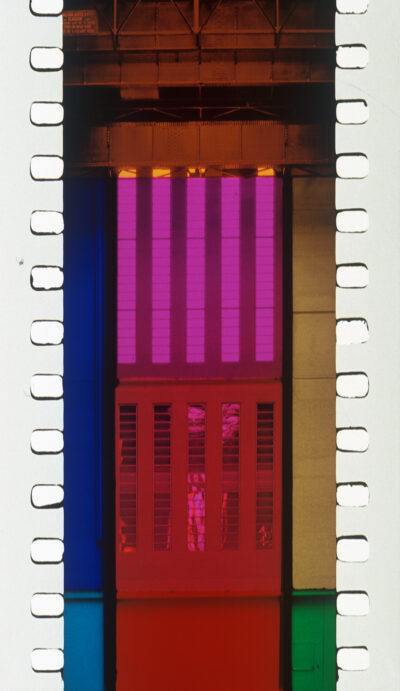
Tacita Dean, FILM, 2011, (Still).
Courtesy the artist, Frith Street Gallery, London, and Marian Goodman Gallery, New York / Paris.
The creative practice of artist Tacita Dean (b. 1965) spans numerous mediums, materials, and disciplines, but she is perhaps most intimately associated with her exquisite and multifaceted work with motion picture film. For more than three decades, Dean has employed film as a crucial and defining means of investigating a vast array of subjects and themes in projects emphasizing the medium’s distinctive capability to give material form to our fleeting, subjective experiences.
Among her nearly one hundred works on Super 8, 16mm, and 35mm film, it is Dean’s monumental 2011 installation FILM that most vividly stands as a testament to the aesthetic and technological qualities that have made the medium so compelling to the artist. Conceived at a time when analogue filmmaking tools and processes seemed in serious jeopardy of disappearing, Dean’s piece acts as both a large-scale tribute and an insistent statement about film’s singular depth, beauty, and vitality.
FILM was created as a commission for Tate Modern in 2011. The eleven-minute-long, silent 35mm film installation takes Dean’s beloved medium as both its material and subject. For its US premiere, the work has been brought to Marciano Art Foundation’s cavernous Theater Gallery. The work’s colossal verticality was achieved by simply turning a Cinemascope lens 90 degrees and standing a normal widescreen on its end, creating an effect reminiscent of the monolith in Stanley Kubrick’s film 2001: A Space Odyssey. The result is a visual poem that takes the form of a monumental filmstrip gloriously emerging from the floor. As FILM unfolds, the viewer experiences complex cinematic compositions that intercut a variety of images—such as a waterfall, a street clock reading 11:11, a pine tree, a smokestack, a flickering bulb, a mountain, and an enormous ostrich egg—with color-filtered shots of the industrial architecture of Tate Modern’s vast Turbine Hall. The projection displays sprocket holes, a normally unseen technical necessity for propelling film through a projector that here is part of the image, giving Dean’s piece the visual quality of an enormous 35mm filmstrip.
In order to create this contemplative paean to the wonder of photochemical film, Dean worked in-camera without recourse to digital post-production, reconceiving century-old silent film era techniques such as glass matte painting, aperture gate masking, and hand-tinting. Taken together, these techniques speak to an emphatic embrace of the qualities of analogue, physical film that are utterly unique to its language and impossible to duplicate or even emulate in a digital format.
As a hallucinatory cinematic apparition, FILM brings the handmade and the visionary together with the playful and the profound, freely collaging in-camera passages of breathtaking beauty and surrealist dissonance with numerous moments of surprise, humor, and absurdity. Regardless of whether we’re aware of the process behind the piece or the labor and ingenuity that it clearly required, the end result is a portrait of film itself and has the effortlessness of an exhilarating magic trick. With its images flowing together like luminous elements of a wordless poem, FILM opens up an uncanny space of reverie and wonder, allowing an underestimated and often overlooked medium to be the immersive subject of its own thrilling spectacle.

Photo by Heather Rasmussen.
Also on view in MAF’s lobby is Dean’s Loss Begets Imitation (Mount Analogue, 1–48) (2026), a new group of forty-eight collages depicting her interpretation of the phantasmic and impossibly colossal mountain that is the subject of the French writer and poet René Daumal’s unfinished 1944 novel Mount Analogue: A Novel of Symbolically Authentic Non-Euclidean Adventures in Mountain Climbing. Introduced to this text by a friend while struggling to conceptualize what would eventually become FILM, Dean began working on a collaged portrait of this fictional mountain using images of the Matterhorn and Helgoland (a German archipelago in the North Sea) drawn from her collection of flea market postcards. Upon completing the image, Dean felt compelled to stick a strip of sprocket holes on either side, like those on the sides of a strip of 35mm film, and it was then she realized that her attempt to conjure an image of Daumal’s elusive and enigmatic Mount Analogue was a parallel attempt to create a portrait of the very analogue medium of motion picture film. As Dean suggests, “Mount Analogue exists for those who do not doubt the possibility of its existence; for those others, it is an impossibility, a fantasy.” This, in short, also describes the poetic qualities of the medium of film itself, which is the subject of her monumental project FILM.
Organized by MAF Director Hanneke Skerath and independent curator Mark Toscano, this marks the first time the work is presented in the United States.

Tacita Dean, FILM, 2011, (Still). Courtesy the artist, Frith Street Gallery, London, and Marian Goodman Gallery, New York / Paris.
Tacita Dean is a British European artist born in 1965 in Canterbury. She lives and works in Berlin and Los Angeles, where she stayed after being the Artist in Residence at the Getty Research Institute in 2014–2015.
Dean has been the recipient of numerous awards including the Queen Sonja Print Award in 2026, the Kurt Schwitters Prize in 2009, the Hugo Boss Prize at the Solomon R. Guggenheim Museum, New York, in 2006, and the Sixth Benesse Prize at the 51st Venice Biennale in 2005.
Solo exhibitions include The Columbus Museum of Art in 2025; the Menil Collection, Houston in 2024; the Bourse de Commerce, Pinault Collection, Paris in 2023; MUDAM, Luxembourg, The J. Paul Getty Museum, Los Angeles in 2022; Kunstmuseum Basel in 2021; EMMA – Espoo Museum of Modern Art, Espoo in 2020; NY Carlsberg Glyptotek, Copenhagen and at the Serralves Museum, Porto in 2019; and at the Kunsthaus Bregenz, The Fruitmarket Gallery, Edinburgh, as well as the Royal Academy of Arts, London, in 2018 as part of a trilogy of exhibitions held in conjunction with the city’s National Gallery and National Portrait Gallery. In 2011 Dean’s work FILM, a part of the Unilever Series of Tate Modern, and shown in the Turbine Hall marked the beginning of the campaign to save photochemical film.

Marciano Art Foundation (MAF) and The Academy Museum of Motion Pictures present a one-night-only screening of artist Tacita Dean’s poignant work, The Uncles, at the AMMP’s Tedd Mann Theater.
Inside the Masonic Temple.